Interior drain tile — also sold as an interior French drain or perimeter drainage system — is a length of perforated pipe set in washed stone in a trench cut along the inside edge of the basement floor, at or just below the top of the footing. Water that has built up in the soil outside enters the stone, drops into the pipe and runs by gravity to a sump pit.
What problem it actually solves
Ohio basements usually leak because of hydrostatic pressure, not because concrete is porous. After sustained rain or a spring thaw, the soil beside the foundation holds more water than it can shed. That water column presses against the footing and the base of the wall.
The seam where the floor slab meets the wall is not a bonded joint — the slab was poured separately. Under pressure, that seam leaks first. Block walls add a second path: the cores fill with water and it weeps out through mortar joints. An interior system relieves the pressure at the footing so neither path has anything to push through.
If your water shows up along the floor edge, start with how cove joint seepage works.
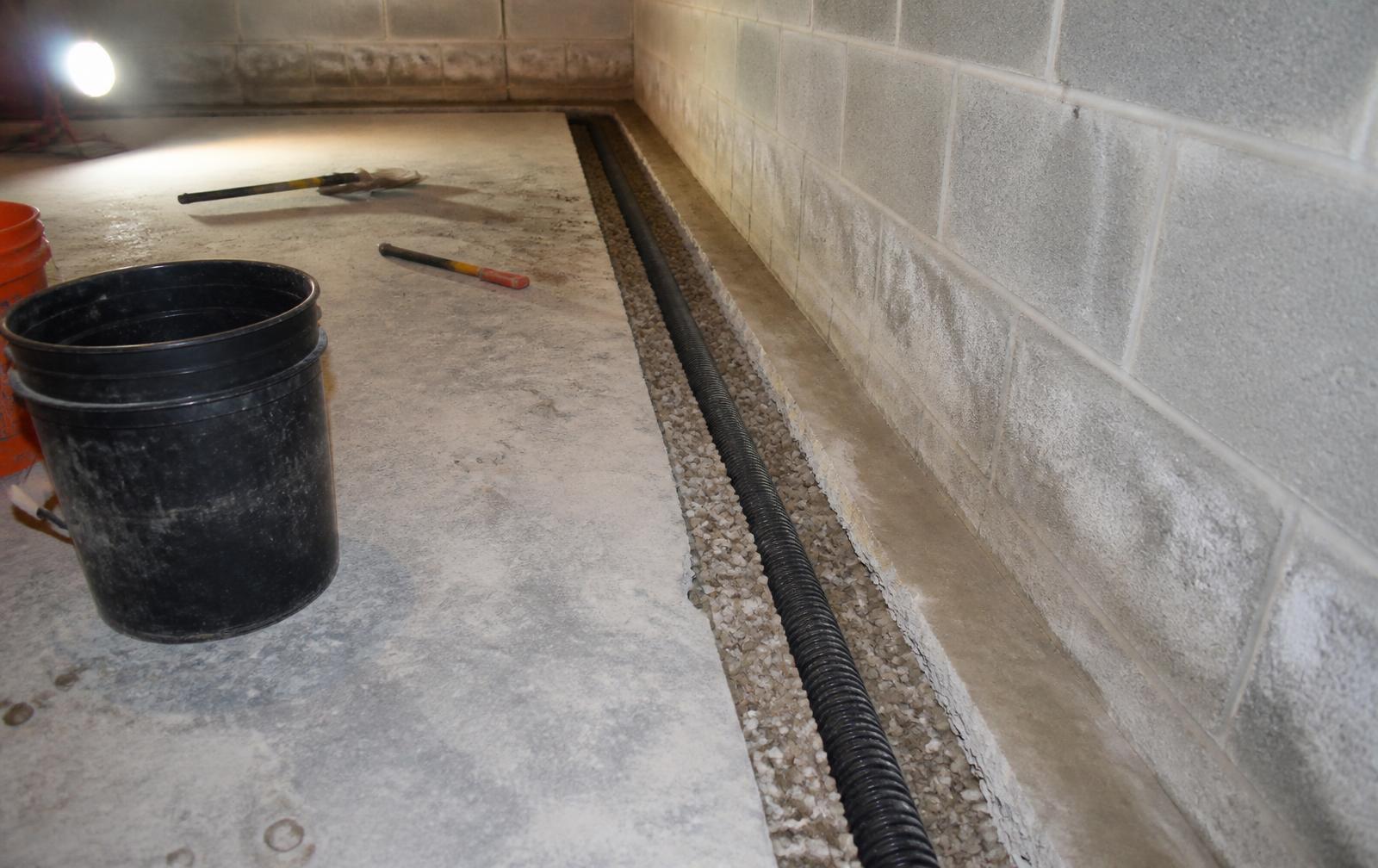
How the installation runs
- Perimeter is cleared and protected; concrete is cut roughly 12–16 inches wide along the wall.
- Slab section is removed and the trench is dug to just below the footing top.
- Perforated pipe is laid in washed stone, pitched toward the sump location.
- On block walls, weep holes or a wall channel let trapped water out of the cores.
- A vapor membrane is often set at the wall base so water enters the stone, not the room.
- New sump pit is set, pump installed, discharge routed away from the foundation.
- Trench is backfilled with stone and the concrete is patched.
What it costs in Ohio
Interior drainage work commonly lands between $3,000 and $12,000. Adding a new sump pit and pump — which most retrofits require — pushes typical full-perimeter projects into the $5,000 to $15,000 band. Linear footage is the biggest lever; access, obstructions like furnaces or finished walls, and slab thickness are close behind. See the Ohio cost breakdown for the full table.
When this is the right call
- Water appears at the floor edge or in low spots after heavy rain.
- The lot is tight, landscaped or bordered by a driveway, making excavation impractical.
- The wall is structurally sound and the issue is water volume, not wall damage.
- An older partial system exists and needs to be extended to the full perimeter.
When it is not enough on its own
Interior drainage does nothing about water entering above the footing — a window well filling up, a leaking hose bib penetration or a crack halfway up a poured wall. Those need targeted work such as crack injection or, in some cases, exterior waterproofing.